
High-Bandwidth Thermal Imaging from the Stratosphere
Balloon experiment • Designed 2024–2025 • Launched 2025
Mission Completed
100%
RATATOSK is a Danish, student-led aerospace experiment demonstrating real-time, high-bandwidth data transmission from the stratosphere. Developed for the BEXUS 36/37 mission under the REXUS/BEXUS programme, the project combines X-band radio communication with thermal infrared imaging to enable Earth observation and ecological monitoring from an altitude of approximately 25 km.
The purpose of RATATOSK was to demonstrate high-bandwidth X-band communication and thermal imaging from the stratosphere. Its objectives included validating reliable real-time data transmission, capturing thermal imagery for ecological monitoring, and providing students with hands-on aerospace engineering experience.
The project addressed a key technical challenge in remote sensing from high-altitude platforms: achieving high-rate, reliable data transmission from a moving, unstable platform with limited power. RATATOSK’s solution was a custom-engineered X-band (8 GHz) radio link, capable of streaming thermal images to a ground station at speeds of up to 40 Mbit/s, even under the dynamic conditions of balloon flight.
A secondary objective was to explore the potential of thermal imaging for environmental monitoring, particularly wildlife tracking. The thermal camera was tested under the extreme conditions of the upper atmosphere, including low temperatures and pressures, to assess operational reliability and imaging accuracy. Pre-flight calibrations, in-flight telemetry monitoring, and post-flight analysis ensured robust system performance.
RATATOSK was a student-led stratospheric balloon experiment focused on technology demonstration in high-frequency RF communication and thermal imaging.
The experiment also lays groundwork for future research into:
- Low-power high-frequency telemetry
- Balloon-based environmental monitoring
- Scalable RF system architectures for remote sensing platforms
Onboard Components:
- Thermal Camera Unit
Captures LWIR imagery for ecological monitoring. - Data Handling Unit (DHU)
An onboard computer system that processes images, applies compression, and manages data flow to the communication system. Includes local storage for redundancy. - X-Band Communication System
Four patch antennas oriented for ground-facing omnidirectional coverage. The system includes a modulator, upconverter, power amplifier, and a frequency-stable local oscillator for reliable signal generation. - Power System
Includes batteries and optional solar panel support. A strict power budget ensures efficiency during the flight, especially during ascent and float when solar input is variable.
Ground Segment:
- Ground Station Unit
A custom-designed receiver system with a high-gain antenna, demodulator, and decoding pipeline capable of handling X-band input and reconstructing transmitted data in near real-time. Real-time image reconstruction and downlink verification tools are implemented. - BEXUS E-Link Interface
Provides low-bandwidth communication for telemetry and experiment control, as well as backup image transmission in the event of X-band link failure.
RATATOSK was flown as part of the BEXUS 36/37 campaign from Esrange Space Center near Kiruna, Sweden. After reaching approximately 25 km altitude, the balloon completed its flight and the experiment safely descended and landed as planned.
After the mission, the balloon will descend by parachute. The payload will be recovered in the Swedish wilderness and brought back for data retrieval and system analysis. DATE unkown.
Launched on BEXUS 36/37 from Esrange, RATATOSK benefits from expert support through the REXUS/BEXUS programme, with contributions from ESA, DLR, ZARM, and SSC. The project paves the way for future CubeSat missions in the DISCO programme.
Scientific and Technical
Background
Stratospheric High-Bandwidth Communication
High-altitude balloons (HABs) occupy a unique operational range—significantly higher than UAVs but below low Earth orbit (LEO) satellites—making them ideal for intermediate-scale Earth observation missions. However, they pose unique communication challenges:
- Variable link distances (up to 500 km)
- Rotational motion and drift affecting antenna orientation
- Severe power constraints due to size, weight, and available energy
- Need for directional antennas to maintain high gain and reduce thermal noise
To overcome these, RATATOSK employs four patch antennas arranged to provide omnidirectional coverage in the Earth-facing plane. The system uses up/down-conversion circuits and a custom-designed RF chain optimized for low noise, energy efficiency, and link robustness. A dedicated ground station tracks the balloon and decodes the incoming X-band data stream, while the BEXUS E-link system serves as a telemetry and command fallback.
Thermal Imaging in the Long-Wave Infrared (LWIR) Window
The project’s secondary payload is a thermal imaging unit operating in the 8–14 µm range, often referred to as the “infrared atmospheric window.” This wavelength range minimizes scattering and absorption in the atmosphere, enabling clearer thermal images from 25 km altitude.
Thermal imaging is used to monitor wildlife during the balloon’s flight, particularly in Arctic regions such as Kiruna, Sweden. Reindeer and similar animals are known to emit significantly more thermal radiation than their surroundings, making them visible with a properly calibrated sensor. The emission data is governed by the Stefan-Boltzmann law, which links emitted radiation to the fourth power of surface temperature. Even small temperature differences can result in detectable thermal signatures.
Technological Validation
Validate the use of a directional, high-frequency radio link (X-band) for live data transmission from a balloon-borne platform. The system includes:
- Custom RF front-end design
- Link budget analysis and optimization
- Onboard error detection and data buffering
- Ground station reception and decoding system
Ecological Observation
Utilize thermal imaging to detect, count, and localize wildlife from the stratosphere, opening up new methods for non-intrusive environmental monitoring, especially in remote and inaccessible regions.
Hands-On Systems Engineering
Provide students with direct experience in aerospace engineering, including:
- RF systems design and testing.
- Embedded systems and image processing.
- Power budgeting under environmental constraints.
- Balloon mission planning, integration, and operation
Curious to know more?
What to discover
BEXUS 36/37:A stratospheric student experience
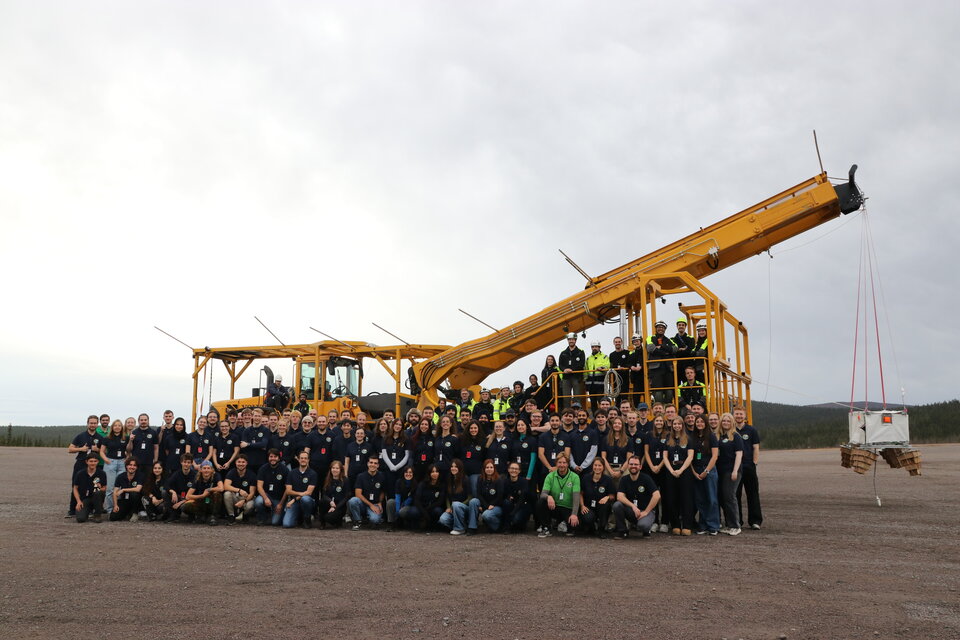
From 3–13 October 2025, 82 university students from across Europe and Canada took part in the launch campaign for two stratospheric balloons, at Esrange Space Center in Kiruna, Sweden, as part of the REXUS/BEXUS programme.
DISCO-3